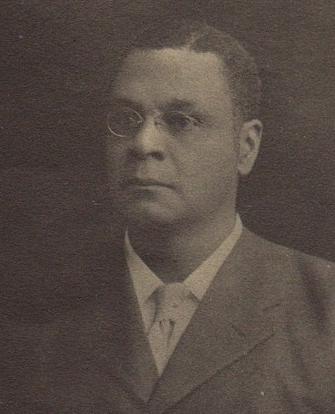
United States Representative George Henry White (1852-1918) was born 18 December 1852 in Bladen County, North Carolina and was the founder of Whitesboro, New Jersey.
Whitesboro founder honored by marker that is template for other Middle sites
Posted: Tuesday, December 24, 2013 12:01 am
By DEVIN LORING, Staff Writer (press of Atlantic City)
For seven months, Cheryl Spaulding worked with Middle Township officials to try to get the founder of Whitesboro, Congressman George Henry White, the recognition that he deserves.
In a long-awaited ceremony Dec. 18, Spaulding, the program administrator for the Concerned Citizens of Whitesboro Inc., finally saw the hard work of the Concerned Citizens and Middle Township Mayor Daniel Lockwood come to fruition.
The Concerned Citizens of Whitesboro saw a marker unveiled that honors White.
"We are so honored to have so many people here," Spaulding said. "We envision there will be many more dedications to George Henry White."
At the ceremony at the intersection of Route 9 and Main Street in Whitesboro, on the day that George Henry White was born in 1852;, historian Luke Alexander spoke about White's legacy.
According to Alexander, White served in the 55th Congress of the United States, but was the last African-American congressman from the Reconstruction Era after the enactment of the Jim Crow laws.
White later established Whitesboro in 1901 as a model community where African-Americans could own land, build businesses and become independent farmers.
"(White) started looking for a way to turn despair into hope, and that's where Whitesboro comes in," Alexander said. "He developed this community for people to advance and to take the barriers off."
The marker - which is located at the site the ceremony took place - will be used as a template for other historic markers for towns in Middle Township.
"We have a lot of history here," Lockwood said. "Middle Township is made up of a whole bunch of communities with their own identities. None are so strong as Whitesboro."
The marker, which was designed in August, had to be redesigned because Lockwood foresaw a marker that didn't "stand alone." The Middle Township logo was added to the marker to make it a cohesive template for other towns.
"Cheryl doesn't just run with it," Lockwood said. "She takes a lot of people with her."
The Concerned Citizens will continue to recognize White in other ways. Alexander, who works with the BESDA Foundation, is working to get White recognized in the Smithsonian.
"There's a lot more going on here under the surface in Whitesboro," Alexander said. "There is pride."
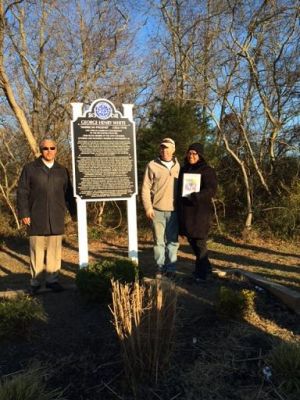
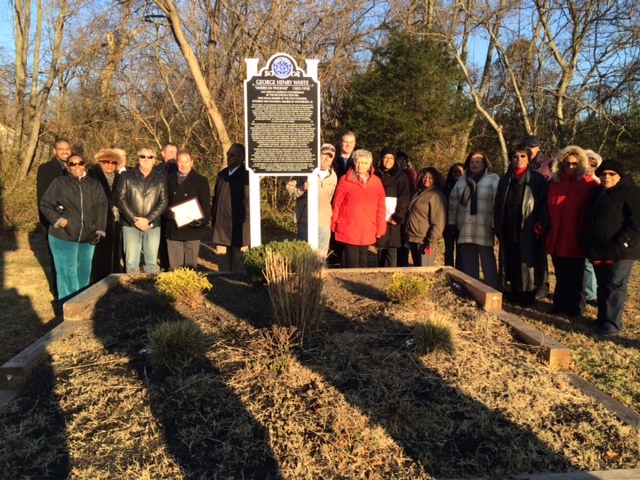
Bernard Blanks, president of the Conercerned Citizens of Whitesboro, Mayor Dan Lockwood, and Cheryl Spaulding, Program administrator of the Concerned Citizens gathered Dec. 18 around the newly erected marker honoring Whitesboro founder Congressman George Henry White.ernard Blanks, president of the Conercerned Citizens of Whitesboro, Mayor Dan Lockwood, and Cheryl Spaulding, Program administrator of the Concerned Citizens gathered Dec. 18 around the newly erected marker honoring Whitesboro founder Congressman George Henry White.
Devin Loring
The Concerned Citizens of Whitesboro gathered Dec. 18 around the newly erected marker honoring Whitesboro's founder, Congressman George Henry White.
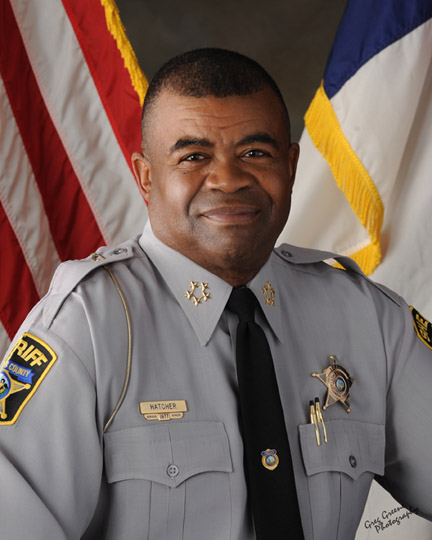
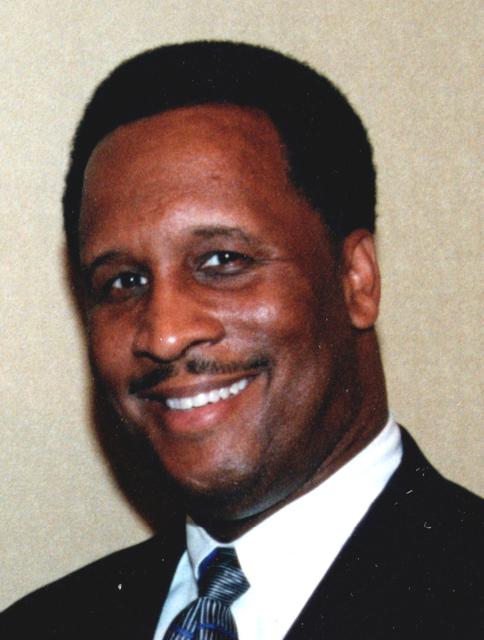
Lewis Lane Hatcher is a veteran law-enforcement officer and former Sheriff of Columbus County, North Carolina, who made history as the first African American to serve as sheriff of Columbus County.
Hatcher devoted much of his life to military service, law enforcement, and public safety. He began his service with three years in the United States Army. After leaving the military, he entered law enforcement, serving approximately two years with the Clarkton Police Department and six years with the Bladen County Sheriff's Office.
Hatcher subsequently joined the North Carolina State Highway Patrol, where he built a distinguished career spanning approximately 26 years. His decades with the Highway Patrol gave him extensive experience in public safety, criminal investigations, traffic enforcement, leadership, and community service.
Following his retirement from the Highway Patrol, Hatcher continued serving the people of southeastern North Carolina. In 2006, he joined the Columbus County Sheriff's Office, eventually rising to the position of chief deputy.
A historic moment came in January 2014, when Hatcher was appointed Sheriff of Columbus County. He later won election to the office, becoming the county's first African American sheriff. His achievement represented an important milestone in the political and law-enforcement history of Columbus County.
Hatcher sought another term in 2018, winning the Democratic primary before facing S. Jody Greene in an exceptionally close general election. The race ultimately became the subject of election challenges and legal proceedings, and Hatcher's tenure as sheriff concluded in December 2018.
Over the course of his career, Lewis Lane Hatcher accumulated more than four decades of military and law-enforcement experience, serving his country, state, and local communities in positions ranging from soldier and police officer to state trooper, chief deputy, and sheriff.
Graham Family Legacy
Lewis Lane Hatcher is the 4th great-grandson of William Graham Sr. and Sarah Jacobs-Graham, an ancestral couple whose descendants have established deep roots throughout southeastern North Carolina and beyond.
Through his long career of public service and his historic achievement as Columbus County's first African American sheriff, Lewis Lane Hatcher holds a distinguished place among the descendants of William Graham Sr. and Sarah Jacobs-Graham.
His story represents another chapter in a family legacy marked by service, leadership, perseverance, and achievement across generations.
George Henry White Exhibit and Film Kick-Off Black History Month Arts and Entertainment | Tue, 02/04/2014 - 4:07 pm | Updated 1 day 1 hour ago | Read 312 | Commented 0 | Emailed 1 By Helen McCaffrey
COURT HOUSE – George Henry White was the last black Republican Representative in Congress elected after the Civil War and his term ended in 1901. He was the Representative from North Carolina’s 55th Congressional District. So why is he important to Cape May County?
On Feb. 1, Pary Tell and Lindsay Rowland, Culture and Heritage Representatives, welcomed visitors to the Beesley House on Route 9 to see an exhibit and hear a presentation regarding White’s life and accomplishments.
White was born in North Carolina in 1852. He was born free. His family had never been slaves. One of his grandmothers was Irish and another was Waccamaw-Siouan Indian. His family worked hard making turpentine from pine trees. They knew the necessity of hard work and the value of education, and White studied hard when his day’s work in the fields and woods was done.
White attended Howard University in Washington, D.C. After that he “read for the law” (this is how people used to become lawyers; law school was not required). Before being admitted to the Bar he worked as a teacher and a principal. Under the sponsorship of North Carolina attorney William J. Clark he was the only black applicant for the North Carolina Bar in 1879.
White was also a successful businessman. As the saying goes “Lucky in business unlucky in love” proved true for White’s first two marriages. Both of his wives died. But then he found lasting love with Cora Cherry.
In 1885, White was elected to the North Carolina state senate. In 1898, White ran for Congress on a national ticket that featured popular Republican William McKinley, who was elected. But catastrophe struck White’s Congressional district when, in that same year, the only coup d’état to ever occur in the U.S. happened in the city of Wilmington. That year, the voters of Wilmington elected a Republican mayor and a Republican city council. It was also bi-racial. The Democrat party, which was an exclusively white party, was unhappy with the election. Agitated by supremacist newspaper editor Josephus Daniels, they formed an armed force and marched through the streets of the city harassing and intimidating black residents. They surrounded the city government buildings and violently forced the Republican elected officials to flee for their lives. The Democrats then put their own people into office.
White, a Congressman, begged President McKinley to send federal troops to restore order. But the best McKinley did was urge Governor Russell to call out the militia. Finally Russell did, but they not only attacked the Ku Klux Klan and the Red Shirts, both paramilitary arms of the Democrat Party, they attacked the beleaguered black population as well. Hundreds of blacks and whites were wounded and 100 African Americans were killed. In addition, 2,100 black residents left the city permanently, conceding power to the Democrats.
White spoke out strongly but he had seen the writing on the wall. North Carolina was the last state to introduce segregation but White knew he could no longer live there. In 1900, the Democrats won a landslide. White’s congressional career ended in 1901.
His farewell speech on the floor of the House was known as the Phoenix speech, for the mythical bird that rises from its own ashes. "This is perhaps the Negroes' temporary farewell to the American Congress,” White said. “But let me say, Phoenix-like he will rise up some day and come again. These parting words are in behalf of an outraged, heart-broken bruised and bleeding, but God-fearing people, faithful, industrious, loyal, rising people – full of potential force."
White's forecast was correct and it was not until 1928 that another African American, Oscar De Priest of Illinois, was elected to Congress.
White preached the Gospel of self-sufficiency and economic power a.k.a. free enterprise. He saw it as a way to raise the condition of the disenfranchised Freemen.
Sheryl Davis Spaulding, who married into the historic family, has taken an active part in preserving and publicizing White’s legacy. A short film to which she contributed, “George Henry White, An American Phoenix,” was shown at the event. It will be shown again on Feb. 12 and Feb. 28 at 7 p.m.
A principal, politician, proprietor and prophet, White moved to Philadelphia in 1905. There, he successfully practiced law and established the People's Saving Bank at 1508 Lombard Street. This bank was able to help African Americans purchase homes and start businesses. But White’s enduring legacy was to establish Whitesboro, a community for migrating African Americans from the Deep South.
Whitesboro was to be a refuge and economic chance for the victims of Jim Crow legislation flooding the Deep South. Luke Alexander told the assembled group at the Beesley House that although White had four children he has no direct descendants. But he does have hundreds of collateral ones, including Alexander and many of the well-known families of Cape May County. They include the Spauldings the Vassers, the Grahams, the Mitchells, the Moores, the Blanks, the Vicks, the Cherrys and the Vances.
“We are his descendants and must champion his memory,” said Alexander.
George Henry White died in 1918 in Philadelphia.
The Exhibition is sponsored by the Concerned Citizens of Whitesboro and the Cape May County Division of Culture and Heritage. It will be open until Feb. 28, Thursdays through Saturdays from 12 p.m. to 4:00 p.m. There is no charge for admission.
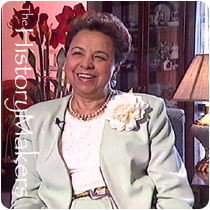
Vera P. Hall was born on February 17, 1937 in Bolton, North Carolina. Her mother was a homemaker and her father was a barber. As a child, Hall enjoyed reading and sewing, even creating her own patterns. She earned a diploma from Armour High School in Armour, North Carolina in 1955. While in school, she was a member of the Hobby and Glee clubs and worked as a school bus driver.
Upon graduation, Hall married her husband, Lawrence, while attending design school in Raleigh, North Carolina. While married with a young child she attended Coppin College and earned her B.S. degree in 1962. She worked as an educator in the Baltimore City public school system from 1962-1975. In 1963, Hall helped to integrate city schools when she was the first African American teacher assigned to an all white school in the city’s “Little Italy” community. During that time she became involved in Maryland state politics, and in 1972 she was appointed to the state central committee by former Maryland Governor, Marvin Mandell.
From 1975 until 1979, Hall worked as a reading specialist for the Maryland State Department of Education. In 1979, she was promoted to assistant superintendent of state schools; she held that post until 1983. Hall was successful in merging education and politics when she accepted a job as legislative liaison at Morgan State University from 1983-1992. While working at Morgan she successfully ran for a seat on the Baltimore City Council. Hall represented the city’s fifth district from 1987-1995. While serving on the council, she also held the position of vice chair of the Maryland Democratic Party from 1989-1992.
Hall made history in 1992 when she was elected as the first African American woman chair of a state democratic party, a position she won by just one vote. Three years later she unsuccessfully ran for Baltimore City Council President and lost by less than 5000 votes.
Hall is an avid quilter and seamstress. She and her husband have two adult children and live in Baltimore, Maryland.
You’d never try to play doctor and diagnose yourself when you’re feeling ill. So why wouldn’t you take the same approach and lean on experts when handling your hard-earned money?
Black women pride ourselves on being resourceful. When we have a question about our health, we’ll talk to our doctor. If our car is making a strange sound, we’ll haul it to the mechanic. Yet, when it comes to our finances, we often try to figure out all the answers on our own. “We believe that we are superwomen and that we should be able to do everything,” says Patricia Stallworth, personal finance expert and author of Minding Your Money: Personal, Money Management and Investment Strategies (BookPartners).
However, our financial choices aren’t always in our best interest. In 2013, the median net worth among Black households was $11,000 compared with $141,900 for Whites, according to a Pew Research Center survey. Black Americans are also underrepresented in the stock market, with 67 percent of African-Americans investing compared with 86 percent of Whites, according to Ariel Investments’ 2015 Black Investor Survey.
A financial adviser can help us maximize our dollars so they start to work for us. But, according to Fidelity Investments, only 47 percent of women are comfortable speaking with a financial professional about their funds compared with 77 percent who are comfortable talking to a medical professional about their health. The wisest people don’t know everything, but they do know where to look for answers. HERE ARE SIX MISTAKES YOU MAY BE MAKING WITH YOUR MONEY AND HOW A FINANCIAL ADVISER CAN SHOW YOU A BETTER WAY.
MISTAKE NUMBER 1
Amassing cash without a plan. As we move up in our careers, it’s natural for us to focus on earning more money. But earning is just the first part of that equation, says Stallworth. The second part is “hav- ing a plan for what you want your money to do.” Without a strategy, we may have a closet full of shoes and an empty bank account, or let our money languish in a savings account when it could be earning 7 percent in the stock market.
Whether your goal is retiring, adopting a child or traveling interna- tionally once a year, an expert can assess the current picture and tell you what you need to do to bring your dream to fruition. The advice can range from adjusting your budget to investing dispos- able income in a particular fund so you can benefit from compound interest. “We’ve seen examples of janitors who have left millions of dollars to schools,” Stallworth says. “It’s not necessarily how much you make, it’s what you do with what you make that really determines the outcome.”
MISTAKE NUMBER 2
Focusing on finances too late. Time is your greatest ally when you want to grow your money. JP Morgan Asset Management’s 2014 Guide to Retirement gives an example of a person who invested $5,000 per year from age 25 to 65 ending up with $1,142,811 compared with a person who invested $5,000 per year from 35 to 65 finishing with only $540,741. That’s why Diane Brown, 52, of Bowie, Maryland, first hired a financial adviser when she was 25. “I felt the earlier I started, it would maximize my dollars on the back end,” she says.
While some women believe they don’t have enough money to warrant consulting a professional, “even if you can’t implement everything in your plan, at least you’ll know what you need to do. So when you get those extra dollars, you can go back and say, ‘Now I can do that,’ ” Stallworth says.
MISTAKE NUMBER 3
Being unprepared for life’s big transitions. We can’t avoid the seismic shifts in our lives, whether it’s a happy occurrence like the birth of a child or a challenging one such as the death of a spouse. But a financial adviser can help us anticipate them. If a woman is getting a divorce, an expert can help her avoid leaving valuable assets on the table. If she’s changing jobs, an adviser can help her determine what to do with the 401(k) or stock options from her previous employer. “My goal, in working with my clients, is to try to provide a safety net,” says Zaneilia Harris, president of Harris & Harris Wealth Management Group in Upper Marlboro, Maryland. “I help clients think about things they wouldn’t think about.”
A pro can also help with long-term planning, such as preparing for health care expenses and life insurance needs and securing premature death protection, says Marina Buatti, vice-president of Women Investors at Fidelity Investments.
MISTAKE NUMBER 4
Taking the wrong approach to tackling debt. Many of us believe that if we are saddled with college loans or owe too much on our credit cards, we don’t have money to invest. Even if we are in the red, “we still need a plan, because sometimes we can’t see our way out of it,” says Sheila Jacobs, a certified financial planner with Wells Fargo Advisors. “In the same way that there are steps to investing to get to your goal, there are steps to getting out of that debt.” Also it may not be wise to put off saving and investing entirely until you’re debt-free. A financial adviser can show you how to do it all at once.
MISTAKE NUMBER 5
Losing money on fees. When it comes to choosing the funds to invest in through our 401(k) plans, some of us use the “eenie, meenie, miny, mo” method. But the funds we select can make a huge difference in earnings over time because of the hidden fees, which average investors don’t know how to spot, Stallworth says. Then years down the line, “they get that final statement and say, ‘My gosh! Where’d my money go?’ ”
A financial adviser can help you identify investments that may be costing you more than they’re worth. “There are so many little tricks inside of your 401(k) that most people don’t even realize,” Stallworth adds.
MISTAKE NUMBER 6
Underestimating the value of knowledge. Some of us have a do-it- yourself mind-set, but there are tens of thousands of investment options. How long would it take for you to research all the different stocks, bonds and mutual funds on your own? That’s the value of going “to somebody who does this all day, every day,” says Jacobs. Not only does a financial adviser understand how the markets work but she or he can also help you determine, based on your goal and time frame, what type of investment is most appropriate for you.
Experts also keep up with changing regulations, which can impact the growth of your money. For example, years ago, the maximum amount you could put in an IRA was $2,000. Today it’s $5,500 for both a Traditional and Roth IRA. If you’re 50 and over, you can add another $1,000 to what’s called a catch-up contribution. If you weren’t aware of the change, you could have missed out on putting away an additional $3,500 or $4,500 toward your retirement.
BOTTOM LINE
A financial adviser is a partner who’s invested in your success. Says Jacobs, “One of my best days ever at work was telling a single female client, ‘Congratulations. You’re a millionaire.’”
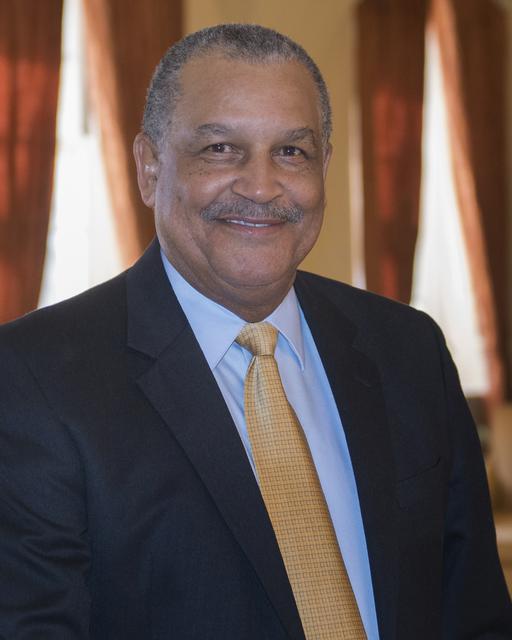
Dr. Blannie E. Bowen is a distinguished educator, scholar, university administrator, and the 4th great-grandson of William Graham, Sr. and Sarah Jacobs-Graham. His long and accomplished career in higher education, particularly at The Pennsylvania State University (Penn State), represents an important chapter in the educational legacy of the Graham family.
A native of Bladen County, North Carolina, Bowen developed an early interest in agriculture, education, and leadership. As a young man, he was active in the Future Farmers of America (FFA) and was among North Carolina's state FFA officers during the 1971–1972 school year.
Bowen continued his education at North Carolina A&T State University, one of the nation's historically Black colleges and universities. He earned both his Bachelor of Science and Master of Science degrees in Agricultural Education from North Carolina A&T. He later attended Ohio State University, where he earned his Ph.D. in Agricultural Education.
His professional career began in higher education, where he established himself as an educator and scholar in agricultural education. Before joining Penn State, Bowen served as an assistant and associate professor at Mississippi State University and later as an associate professor in the Department of Agricultural Education at Ohio State University.
In 1988, Dr. Bowen joined Penn State University as the C. Lee Rumberger and Family Chair of Agriculture. His abilities as an educator and administrator led to increasingly important leadership positions within the university.
Bowen served as interim head of Penn State's Department of Agricultural and Extension Education, undergraduate programs coordinator, associate dean for graduate programs and senior faculty mentor in the Graduate School and eventually head of the Department of Agricultural and Extension Education from 1998 to 2004.
In July 2004, Bowen reached another milestone when he was appointed Vice Provost for Academic Affairs at Penn State University. In this senior leadership position, he worked directly with university presidents, provosts, college deans, campus chancellors, faculty, and other administrators on matters affecting the academic direction of one of the nation's major research universities.
His responsibilities included faculty development and evaluation, leadership development, promotion and tenure, executive searches and reviews, and other academic and personnel matters. He also served as a liaison between Penn State's faculty and university leadership and represented the administration in its relationships with the University Faculty Senate and the Big Ten Academic Alliance.
Bowen was a member of Penn State's President's Council and Academic Leadership Council, placing him among the university administrators involved in significant decisions concerning academic and curricular affairs. In 2016, he was also appointed to the Pennsylvania College of Technology Board of Directors.
Throughout his career, Bowen became recognized nationally for his contributions to agricultural education, communications, faculty development, academic leadership, and diversity in higher education.
His alma mater has also remained an important part of his life. In 2017, Dr. Blannie Bowen and his wife, Dr. Cathy Bowen, established an endowed scholarship at North Carolina A&T State University to assist students in the College of Agriculture and Environmental Sciences. The couple met while attending North Carolina A&T and later enjoyed distinguished careers at Penn State.
Bowen's professional accomplishments earned him numerous honors. Among them was the 2009 Distinguished Alumni Award from The Ohio State University's College of Food, Agricultural, and Environmental Sciences Alumni Society.
After nearly 30 years of service to Penn State University, including approximately 13 years as vice provost for academic affairs, Dr. Bowen retired on June 30, 2017. Penn State officials praised his insight, leadership, and contributions to the university's faculty, students, academic programs, and administration.
Dr. Bowen's commitment to service extended beyond the university. He was active in his church and community, serving for many years with Albright-Bethune United Methodist Church in State College, Pennsylvania, and volunteering as a Little League baseball and YMCA basketball coach.
As the 4th great-grandson of William Graham, Sr. and Sarah Jacobs-Graham, Dr. Blannie E. Bowen represents an extraordinary example of educational achievement and leadership among their descendants.
From his North Carolina roots and education at North Carolina A&T State University, to earning his doctorate from The Ohio State University, and ultimately becoming one of the senior academic administrators at Penn State University, Dr. Bowen built a career centered on education, scholarship, leadership, mentorship, and service.
His accomplishments stand as another distinguished chapter in the continuing history of the descendants of William Graham, Sr. and Sarah Jacobs-Graham, demonstrating how the family's legacy has extended from southeastern North Carolina into some of the nation's leading institutions of higher education.
Pender County Board of Education names principal of Cape Fear Middle School
posted Jul 7, 2017, 9:31 AM by Miranda Ferguson [ updated Jul 7, 2017, 9:31 AM ]
Pender County Board of Education names principal of Cape Fear Middle School
PENDER COUNTY — The Pender County Board of Education has appointed Christie Brown Principal of Cape Fear Middle School.
Christie Brown holds a bachelor’s degree from the University of North Carolina Wilmington, master’s degree in school administration from the University of North Carolina Pembroke, and is currently pursuing a doctorate in educational leadership at Gardner Webb University. She brings much experience to Cape Fear Middle School, having served in neighboring Bladen and Columbus counties as a teacher, assistant principal, and principal.
Brown said she values relationships and looks forward to building relationships with students, staff, and the community.
“I look forward to working in collaboration with the staff and community as Cape Fear Middle School moves to the next level,” Brown said.
Brown lives in Bladen County with her husband of 23 years, Cecil. The couple have a 16-year-old son, Branden, and 20-year-old daughter, Kayla, who is a junior at Methodist University.
“Mrs. Brown will be an asset to Cape Fear Middle School,” said Dr. Terri Cobb, Superintendent of Pender County Schools. “Her experience and expertise at the middle school level will positively impact student achievement.”
A meet-and-greet event will be scheduled for students, staff, parents and community members to get to know Mrs. Brown at a later date.
James T. Butts Jr. is a nationally recognized law-enforcement executive, municipal leader, and longtime Mayor of Inglewood, California. With more than five decades of experience in public safety and municipal government, Butts has built a distinguished career encompassing policing, airport security, public administration, transportation, and city leadership.
He is also a 3rd great-grandson of William Graham Sr. and Sarah Jacobs-Graham, connecting his achievements in California to the Graham family's deep roots in southeastern North Carolina.
Education and Law Enforcement Career
Butts earned a Bachelor of Science in Business Administration from California State University and a Master of Business Administration from California Polytechnic University.
His public-service career began in law enforcement. He spent 19 years with the Inglewood Police Department, rising through the ranks to become Deputy Chief of Police.
Butts later became Chief of Police for the City of Santa Monica, a position he held for approximately 15 years. His experience and leadership eventually took him to Los Angeles World Airports (LAWA), where he served as an assistant general manager responsible for Public Safety and Counterterrorism.
In that position, Butts oversaw security operations involving more than 1,100 sworn and civilian personnel protecting the Los Angeles World Airports system, including Los Angeles International Airport (LAX). His responsibilities included law enforcement, security, traffic control, and homeland-security operations.
Mayor of Inglewood, California
On February 1, 2011, James T. Butts Jr. was sworn in as the 12th Mayor of Inglewood, California.
His tenure has coincided with one of the most significant periods of redevelopment in Inglewood's modern history. Under his leadership, the city has become a major center for sports, entertainment, economic development, and investment in the Los Angeles metropolitan area.
Among the major developments associated with Inglewood's transformation are SoFi Stadium, home of the Los Angeles Rams and Los Angeles Chargers, and the Intuit Dome, home of the Los Angeles Clippers. His administration was also involved in efforts surrounding the revitalization of the historic Forum.
Butts has emphasized improving Inglewood's financial position as well as attracting development and strengthening public services. According to the City of Inglewood, the city's bond rating has risen to AA+, while its financial reserves have grown substantially during his administration.
His political support has also been demonstrated at the ballot box. On November 4, 2014, Butts was reelected mayor with more than 83 percent of the vote, which the City of Inglewood describes as the largest margin of victory in the city's electoral history. He subsequently won additional terms in 2018 and 2022.
His regional leadership has extended beyond Inglewood. Butts has served on the Los Angeles County Metropolitan Transportation Authority (Metro) Board of Directors and has served as its chairman.
Inglewood is also positioned to play a major role in the 2028 Olympic and Paralympic Games, further placing the city on an international stage.
Graham Family Legacy
Beyond his accomplishments in law enforcement and municipal government, Mayor James T. Butts Jr. is a 3rd great-grandson of William Graham Sr. and Sarah Jacobs-Graham, whose family was established in southeastern North Carolina during the nineteenth century.
His story demonstrates the extraordinary geographic reach of the Graham family—from its early roots in Bladen and Columbus counties, North Carolina, to positions of leadership across the United States.
From police officer to deputy police chief, police chief, airport public-safety executive, and ultimately mayor of a major American city, James T. Butts Jr. has devoted more than half a century to public service.
As a descendant of William Graham Sr. and Sarah Jacobs-Graham, Mayor James T. Butts Jr. represents another distinguished chapter in a family legacy of leadership, perseverance, achievement, and service to community.
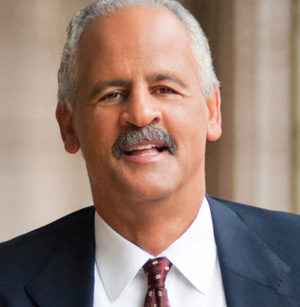
Stedman Graham
Stedman Graham is a nationally and internationally recognized American businessman, educator, author, motivational speaker, leadership expert, and United States Army veteran. Born March 6, 1951. Graham has built a distinguished career centered on education, personal development, leadership, entrepreneurship, and service to others. He is the son of Stedman Graham and Mary Jacobs Graham.
An important part of Graham's heritage reaches back to southeastern North Carolina. Through his Graham family ancestry, Stedman Graham is the second great-grandson of William Graham Sr. and Sarah Jacobs-Graham, an ancestral couple whose descendants spread throughout North Carolina and beyond.
Early Life and Education
Graham grew up in the historically African American community of Whitesboro, New Jersey. Basketball became an important part of his youth and helped provide him with educational opportunities. He attended Hardin-Simmons University in Abilene, Texas, on a basketball scholarship and graduated in 1974 with a bachelor's degree in social work.
He continued his education at Ball State University, earning a master's degree in education. He has also received honorary doctorates in recognition of his accomplishments and contributions.
Military Service and Professional Basketball
Graham served his country as a member of the United States Army. During this period of his life, he also played professional basketball in the European League. His experiences in athletics and the military contributed to discipline, perseverance, teamwork, and self-development principles that would later become central themes of his professional work.
After his military service, Graham entered the federal corrections system. He advanced professionally and eventually became Director of Education at the U.S. Metropolitan Correctional Center in Chicago. He later moved into public relations and worked as a vice president with B&C Associates in High Point, North Carolina, where he gained valuable experience in communications, marketing, and organizational leadership.
Business Leadership
In 1988, Graham founded S. Graham & Associates, a management, marketing, and consulting firm. As its Chairman and CEO, he developed programs designed to help individuals and organizations improve leadership, performance, education, and personal development.
His work has taken him around the world, conducting leadership programs in countries including Germany, China, Canada, the United Kingdom, the Netherlands, Bermuda, and South Africa. His clients have included major corporations and government organizations.
Author and Identity Leadership Pioneer
One of Graham's greatest professional contributions has been his work in Identity Leadership. His philosophy teaches that effective leadership begins with understanding and developing oneself. He emphasizes that people must first determine who they are, recognize their talents and abilities, establish a vision, and organize their lives around that identity before they can effectively lead others.
Graham developed his well-known Nine Step Success Process®, which provides a framework for personal and professional growth.
He is the author of 12 books, including two New York Times bestsellers and a Wall Street Journal bestseller. His works include You Can Make It Happen: A Nine-Step Plan for Success, Teens Can Make It Happen: Nine Steps for Success, Identity: Your Passport to Success, and Identity Leadership.
Educator and Mentor
Education has remained one of the central themes of Graham's life. He has served as a distinguished visiting professor and lecturer at colleges and universities and was formerly an adjunct professor at Northwestern University's Kellogg School of Management, where he taught a course titled The Dynamics of Leadership.
His teachings have particularly emphasized helping young people understand that their circumstances do not have to determine their future. Through education, preparation, discipline, and self-knowledge, Graham encourages individuals to define themselves rather than allowing society to define them.
Commitment to Youth and Community
Graham has maintained strong ties to community development throughout his career. He founded the Concerned Citizens of Whitesboro in his native New Jersey as well as the Concerned Citizens of Lake Waccamaw, North Carolina. He also co-founded the Community Alliance for Youth Success (CAYS).
His Teens Can Make It Happen program has been used in middle and high schools in the United States and abroad, extending his philosophy of education, identity, and personal responsibility to younger generations.
The Graham Family Legacy
Stedman Graham's accomplishments also form an important chapter in the larger history of the descendants of William Graham Sr. and Sarah Jacobs-Graham.
As their second great-grandson, Graham represents a branch of the family whose story extends from southeastern North Carolina into New Jersey and ultimately onto the national and international stage.
His journey—from his childhood in Whitesboro to college athletics, military service, education, entrepreneurship, authorship, and international leadership training—reflects themes that have characterized generations of the Graham family: perseverance, education, service, leadership, and determination.
Today, Stedman Graham stands among the accomplished descendants of William Graham Sr. and Sarah Jacobs-Graham. Through his work as an educator, businessman, author, veteran, and advocate for young people, he has built a legacy centered on helping others discover their identity, develop their abilities, and use their lives in meaningful service to their communities.
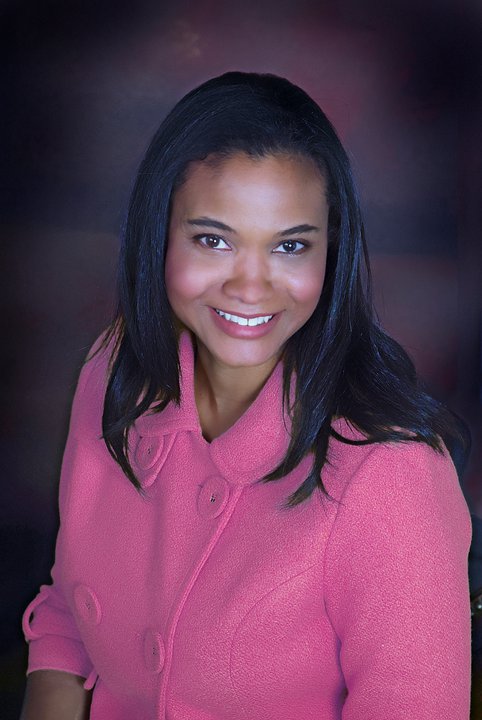
Bladen County, North Carolina native Dr. Jennifer Smith named superintendent in China
Dr. Jennifer Smith
Columbus County, North Carolina Sheriff
Bladen County native Dr. Jennifer Smith has been named a superintendent in Beijing, China. She is the daughter of Shirley Autry and the late Houston Smith.
China’s education system has a great reputation and is considered one of the most challenging and competitive systems in the world, with accountability standards that exceed most countries.
Smith has a wealth of knowledge and expertise in leading large international educational settings. Prior to taking the leap to work overseas, she was a principal in Charlotte-Mecklenburg Schools.
Smith left Charlotte to work overseas in South Korea, where she opened a new school as principal. While working in Asia, her expertise led her to the Middle East, where she was a superintendent of schools in Abu Dhabi, United Arab Emirates, for six years. It was a system which had more than 300 schools and 500,000 students.
After serving six years as superintendent in Abu Dhabi, Smith had the opportunity to serve as Continent Education Director for 17 countries within the continent of Africa, overseeing the education in Kenya, Tanzania, Uganda, Ethiopia, Somalia, Dibouti, Eritrea, Angola, Botswana, Lesotho, Malawi, Mozambique, Namibia, South Africa, Swaziland, Zambia, and Zimbabwe.
Smith has one daughter, Halle, an 11th grader at Black Forest Academy, a private international boarding school in Germany.
“I’ve been blessed with so many wonderful opportunities in both my career and personal life,” Smith said. “Professionally and personally, I’ve always done my best to make a name for myself by my service to others. Throughout my career, the Lord has guided my footsteps to make a difference in the lives of so many children, educators, and parents around the world in the following countries: USA, South Korea, United Arab Emirates, the continent of Africa, and now China.
“China’s educational system is one of the most rigorous ones in the world, in which accountability standards, professionalism, and student achievement are top priorities. I’m thrilled to be leading this educational journey for students, teachers, and parents of China.”
Heading from Wilmington towards Whiteville on Highway 74/76, you've inevitably seen a piece land filled with various types of yard art.
The first thing that you notice is a 20 foot Uniroyal gal, a rare piece of Americana, one of only 11 left in the entire country. Then there are clowns, chickens, horses, bears, bulls, lions and crocodiles - the list goes on and on.
"People are so excited about it, they drive down the road they drive back and they say what is this what is this all about? So a lot of times I find myself being repetitive and telling the story over and over again," Hubert Graham said.
The story of how these 250 fiberglass figurines came to be dates back to a time in 1996 when he and his wife were robbed. Thieves made out with the couple's checkbooks and cash. It sparked an idea in Graham.
"At that time I told my wife, 'You know, I am going to build something outside the road to detour people but something that records and lights up when someone enters the driveway,' and boom the lighthouses were born," Graham explained.
What started out as Graham selling handmade 8-foot lighthouses, quickly transpired into a fantastical fiberglass feat.
He learned the art of making the oversized objects from a friend and mentor.
"I started buying molds from my friend Bill," Graham said. "He had about 55 to 60 molds and started making fiberglass and then I started making molds. Eventually, I got more technical on how to make everything from animals to boats."
But his dream is much bigger than just making fiberglass art. His goal is to use the fiberglass animals to create Columbus County's first amusement park and mini golf course. Just hearing him talk about is enough to get anyone excited.
"I am making 10 of every animal. I have 75 molds so that is 750 animals. Put a motor in the middle of each one add a saddle to them cover up and then make it a merry go round, then that way you can ride a chicken you can ride a horse you can ride a cow, a bull a bear, a calf a sheep, you can ride whatever I make," Graham said full of excitement.
He is catering the park to the autistic or those with disabilities as well - a giant sized dream fueled from being shunned at church in the 1970s. He was the only black boy in a white church choir in Columbus County.
"One day the pastor tapped me on the shoulder and he said hey, some of the members don't want you inside of this church," said Graham, adding that the incident taught him that everyone should be treated equally and can co-exist together.
Graham hopes to have the park up and running in the next eight months.
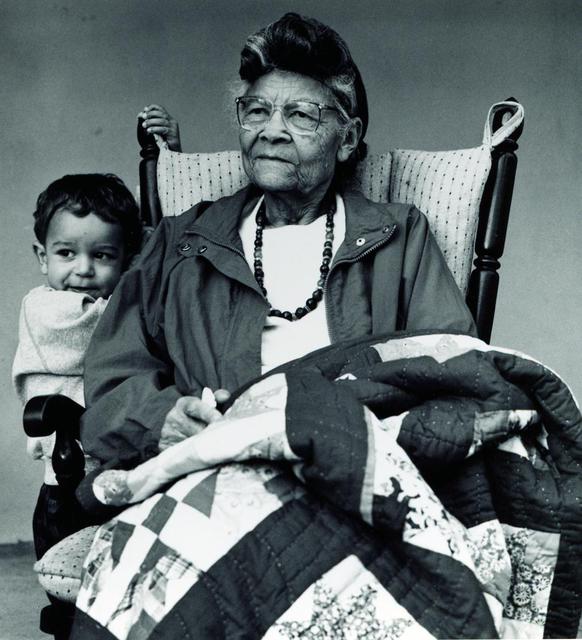
Elizabeth “Lee” Graham Jacobs (1909–2000) was a celebrated North Carolina quiltmaker and respected tradition bearer from the Waccamaw Siouan community of Buckhead in Columbus County, North Carolina. Her remarkable skill in quilting, dedication to her family and community, and commitment to preserving traditional craftsmanship earned her statewide recognition and a lasting place in North Carolina's cultural history.
Known affectionately in her community as “Mrs. Lee,” Jacobs spent virtually her entire life in the Buckhead community, living within only a few miles of where she was born. Quilting was part of her family heritage. She learned to sew and piece quilts as a young girl, receiving scraps of cloth from her grandmother and sitting beside her as she worked. Jacobs recalled that her grandmother's mother had also been a quilter, demonstrating that the tradition had been passed through several generations of women in her family.
Jacobs favored what she called “old-time quilts.” Rather than depending upon printed patterns or instruction books, she relied upon knowledge, memory, creativity, and skills learned within her family. Materials available around the household—including sewing scraps, feed sacks, and sackcloth—could be transformed into colorful and intricate quilts.
Her quilts were much more than bed coverings. They marked important moments in the lives of the people she loved. Jacobs created wedding quilts, baby quilts, and housewarming quilts, turning pieces of cloth into permanent records of family milestones. She said she was able to provide quilts for each of her seven children and later made quilts for her grandchildren.
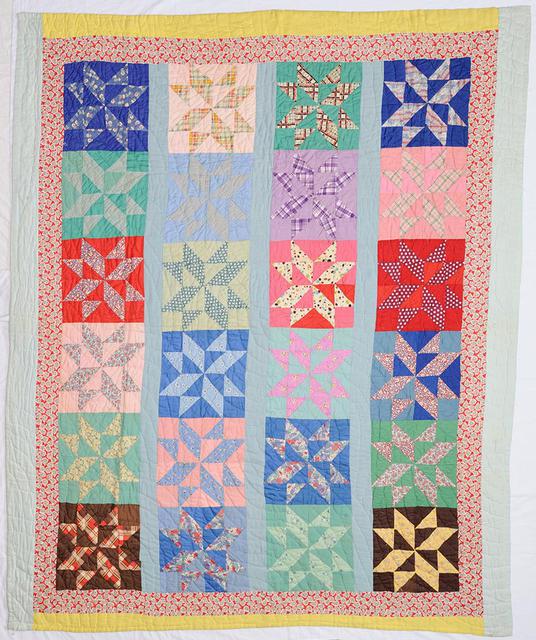
One of her best-known surviving works is an Eight-Pointed Star quilt dating from approximately 1963–1967. Made from sewing scraps and printed feed sacks, the 24-block quilt was associated with the 1967 marriage of her daughter Vonnie. The quilt eventually became part of the collection of the North Carolina Museum of History, preserving Jacobs's craftsmanship for future generations.
Service to Her Community
Jacobs's quilting also reflected her generosity. She gave quilts to family and friends and helped neighbors who had suffered losses such as house fires. Her quilts were also raffled at powwows to raise money for Waccamaw Siouan tribal charities. Just as importantly, she shared her knowledge by teaching quilting to members of her family and younger people in the community, helping ensure that the tradition would continue into another generation.
Her work became part of a larger effort to document the quilting traditions of the Waccamaw Siouan people. During the 1990s, the project “Waccamaw Siouan Quilters: Piecing the Past and Future” documented more than 80 quilts and helped bring greater public recognition to quilting as an important element of Waccamaw Siouan cultural heritage.
North Carolina Heritage Award
In 1996, Elizabeth “Lee” Graham Jacobs received the prestigious North Carolina Heritage Award, the state's highest honor for traditional artists and practitioners.
The North Carolina Arts Council recognized Jacobs among a distinguished group of 1996 recipients that also included legendary bluegrass musician Earl Scruggs. The award honored Jacobs not simply for creating beautiful quilts, but for carrying forward an artistic tradition deeply rooted in family, community, and cultural heritage.
Her importance to Native American cultural history in North Carolina is also recognized by the North Carolina Commission of Indian Affairs, which identifies Elizabeth “Lee” Graham Jacobs as a Waccamaw Siouan quilter and 1996 North Carolina Heritage Award recipient.
Graham Family Legacy
Elizabeth “Lee” Graham Jacobs was the daughter of Joseph William Graham and Prudy Jane Jacobs-Graham. She was among their children raised within the Graham family's longstanding Columbus County community.
Through her Graham ancestry, Elizabeth “Lee” Graham Jacobs was a 2nd great-granddaughter of William Graham Sr. and Sarah Jacobs-Graham.
Her life represents an especially meaningful part of the Graham family story because she preserved something that cannot be measured simply through names and dates on a family tree. Through her hands, scraps of fabric became family heirlooms, wedding gifts, charitable contributions, works of art, and expressions of Waccamaw Siouan cultural heritage.
Today, Elizabeth “Lee” Graham Jacobs is remembered as one of North Carolina's distinguished traditional artists. Her quilts survive as tangible reminders of the knowledge passed from one generation to another and of the creativity and resilience of the women who helped sustain their families and communities.
As a 2nd great-granddaughter of William Graham Sr. and Sarah Jacobs-Graham, Elizabeth “Lee” Graham Jacobs holds a distinguished place among their descendants—a master quiltmaker whose artistry became part of the documented cultural heritage of the State of North Carolina and the Waccamaw Siouan people.
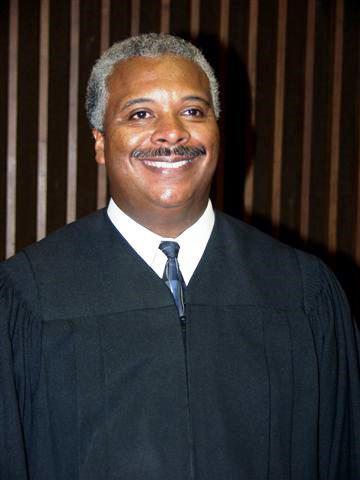
Chief District Court Judge Edward A. Pone
Chief District Court Judge Edward A. Pone is a distinguished North Carolina jurist whose decades of public service have included leadership in the courts of Cumberland County, advocacy for children and families, and innovative judicial programs addressing substance abuse and juvenile justice.
Judge Pone earned his Bachelor of Arts degree from North Carolina Central University in 1979 and his law degree from the University of North Carolina at Chapel Hill School of Law in 1982. His legal career included work in private practice as well as service as an assistant public defender, giving him experience representing individuals within North Carolina's criminal justice system.
In 1996, Governor Jim Hunt appointed Edward A. Pone to the North Carolina District Court bench. He subsequently earned the confidence of voters and was elected and reelected multiple times to continue serving as a District Court judge.
Throughout his judicial career, Judge Pone developed a particularly strong record of service involving families, children, juveniles, and treatment courts. He became a certified juvenile court judge and served as a presiding judge in the Cumberland County Family Court, handling both domestic and juvenile matters.
Judge Pone also served as the presiding judge of the Cumberland County Family Drug Treatment Court, an initiative created to address the connection between substance abuse and family instability. North Carolina judicial records show his involvement with Cumberland County's Family Drug Treatment Court dating to its development and implementation in the mid-2000s.
His community-centered approach to justice extended to serving as presiding judge of the Cumberland County Misdemeanor Diversion Program and as a Judicial Fellow with the Cumberland County Reclaiming Futures Initiative, which focused on assisting young people facing substance-abuse challenges.
A major milestone in his career came in January 2019, when North Carolina Supreme Court Chief Justice Cheri Beasley appointed Judge Edward A. Pone Chief District Court Judge for Judicial District 12, which at the time covered Cumberland County. Chief Justice Beasley later formally swore him into the leadership position. As Chief District Court Judge, Pone assumed responsibility for helping administer one of North Carolina's major district court systems while continuing his commitment to fair and effective justice.
His career represents more than professional accomplishment; it is also part of a much longer family story.
Edward A. Pone is a 3rd great-grandson of William Graham Sr. and Sarah Jacobs-Graham, an ancestral couple whose descendants have made important contributions throughout North Carolina and beyond. Through this Graham-Jacobs heritage, Judge Pone represents another generation of descendants who carried the family's legacy into public service, education, law, and community leadership.
From the lives of William Graham Sr. and Sarah Jacobs-Graham in nineteenth-century southeastern North Carolina to the judicial leadership of their descendant Edward A. Pone, his story illustrates the remarkable progress of succeeding generations of the family.
Judge Pone's legacy is especially significant because his judicial service centered on people at some of the most difficult moments of their lives—children, parents, families, defendants, and individuals struggling with addiction. His long tenure on the bench and eventual elevation to Chief District Court Judge stand as a distinguished chapter in the history of the descendants of William Graham Sr. and Sarah Jacobs-Graham.
Brothers from East Arcadia, North Carolina making a difference through mental health counseling
EAST ARCADIA — More than 20 years ago, they grew up on this southern end of Bladen County.
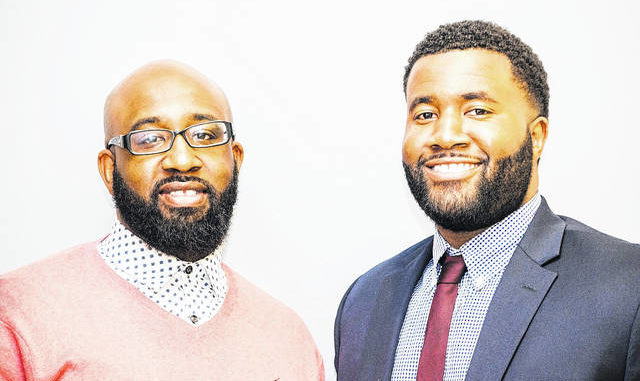
Today, Drs. Travis and Anthony Andrews own and operate Andrews Counseling and Consulting, a mental health agency with offices in Burlington and Charlotte. They provide psychological therapeutic services to individuals and their families, specializing in rehabilitation, trauma and addictions. Travis works in Burlington, Anthony in Charlotte.
The sons of Mary Lou Dixon Andrews and Arvis Andrews, raised respectively in East Arcadia and Carvers Creek, remember a community where the old adage a village raises the child was true as ever. These days, they have worries for their hometown, the children coming out of it, and other communities like it spread across the state.
“We need to realize our history, and where we came from,” Travis says. “Individuals who passed that torch to us — it’s our duty to keep it lit. Sometimes, staying keen to those values that made East Arcadia strong is what is going to help keep it going in the future.”
Credit older brother Travis, East Bladen Class of 2002, with shaping some of the trajectory of Anthony, East Bladen Class of 2007.
“Coming from a background of educators in my family, I knew that I didn’t want to be a teacher, but I wanted to help others in different ways,” Travis, now 36, says. “I decided to do it through the use of therapy. I’ve seen my mother, and my uncles and aunts, were all educators. They would always provide, go the extra mile, have the encouraging voice. I said, ‘What can I do?’ It turned into a therapist.”
He earned his undergraduate, master’s and doctorate all at North Carolina A&T. Anthony, now 31, earned his undergraduate degree from Shaw.
“He wanted to go law. He was a big law guy,” Travis says with a chuckle. “I was like, we could make a better connection before the individuals get into the prison system. Let’s touch them through therapy. It took some convincing. I told him I can’t do this without you.”
Anthony obliged, following the footsteps and earning his master’s and doctorate at A&T as well.
Their doctorates are in rehabilitation counseling and counselor education.
“Coming from an environment, right now in East Arcadia, we knew that there was a high rate of substance abuse, trauma, and we really just wanted to make some sort of change growing up once we got out of East Arcadia,” Anthony says. “I personally was looking to get into law school, but after getting accepted, my brother was already in the mental health program at North Carolina A&T. He convinced me to switch paths.
“I wanted to work with youth on the juvenile side of law. When we picked this, we knew there weren’t a lot of males, and not a lot of African-American males. We wanted to make some change, to try and decrease the traumatic and behavioral challenges that many in the community face.”
Before the coronavirus struck, Travis said each of them would do sessions between 9 a.m. and 5 p.m., everybody from individuals to families. They’ve counseled in communities, at Fort Bragg with the military, just about any and everywhere.
“We have so many that need services,” Anthony says. “We probably see six or seven a day each.”
Once COVID-19 became a part of life, reducing face-to-face interactions and requiring social distancing, sessions continued but through the internet.
Success, Anthony says, is “knowing that families can be healed, and can be talking and having conversation.”
“A lot of issues go unaddressed because they don’t have the conversation, or address the trauma. We knew growing up, that meant really just being content and happy with what you’re doing. My grandfather, at the age of 91, received his GED.
“He passed at 102, but he would be thrilled to see his grandsons holding doctorates and being in the mental health profession. We’re giving back and paying forward what we were instilled with.”
Travis says what he expected and what he found were beyond imagination.
“There’s more disparities and inequalities than you can fathom,” he says. “To combat some of these disparities, we understood more programs and resources were needed. Therapy helps with talking about some of that trauma and distress, but it’s not the problem-solver for all. That’s what we realized through the process. It helps, but it’s not the problem-solver.
“So we went and got our Ph.D. so we could get more grants. We realized that the community needs more. That’s where we’re at now — how can we provide more resources, grants or programs, to help these individuals?”
The community where they were raised shaped them greatly, starting in their home.
“That phrase it takes a village to raise a child — that was there,” Travis says. “And I’m looking at that now, on that scope, more people were there, more jobs, less crimes. Other men, and women, in the community could help. The church was heavily involved.”
Anthony said whether in urban areas, as they are in now, or in rural communities, a message of hope is no different.
“Our goal is to get rid of the negative stigma associated with counseling,” he says.
Choosing to “keep it in house,” he adds, isn’t the best option.
“We want to remove the stigma, encourage people to go out and check on their mental health, and really speak to a mental health professional as they would a doctor,” he continued. “Counseling is a profession you can go into. Rarely do you hear they want to go to school and be a therapist. They have to see that, and some representation of that. My hope is many people will go so they can come and help people after them.”
Alan Wooten can be reached at 910-247-9132 or [email protected]. Twitter: @alanwooten19.
Hubert Graham
The Descendants of William Graham Sr. and Sarah Jacobs